CORE is one of only four Level‑3 Registry Service Providers (RSPs) accredited by ICANN worldwide for the management of variant TLDs.
This designation places CORE among a select group of experts fully equipped to support applicants on all IDN‑related matters — whether enabling variants at the second level or operating variant TLDs.
CORE has long been a pioneer and strong advocate for Internationalized Domain Names (IDNs). With .cat, CORE launched the first TLD to offer IDNs from the outset — and the first to implement variant handling by treating diacritics as variants. Every TLD we manage provides IDN support, and all three of our own TLDs are IDN TLDs.
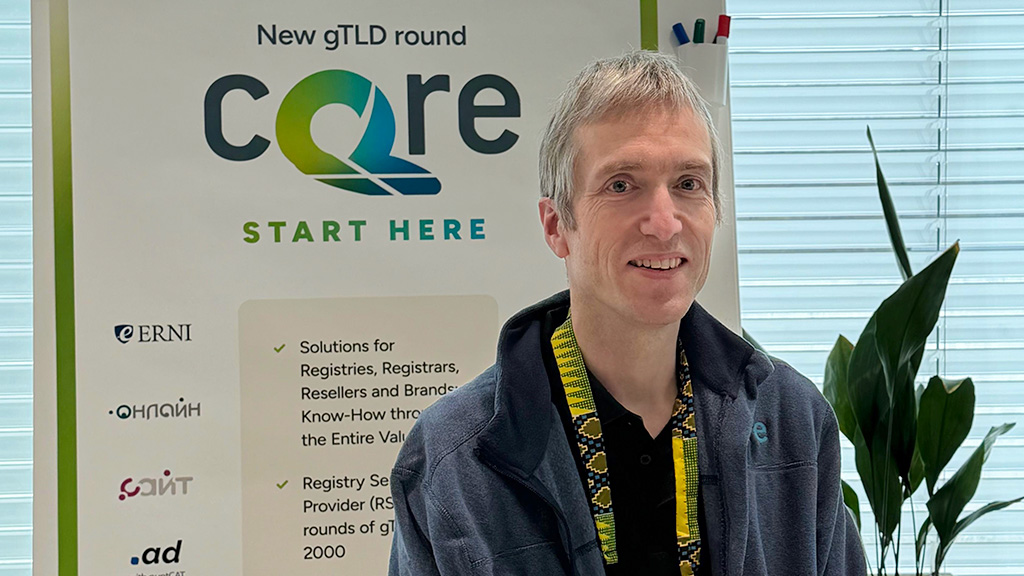
In this blog post, Dr. Michael Bauland presents the latest initiatives and achievements that reaffirm CORE’s ongoing commitment to innovation and linguistic inclusiveness.
What major scripts do the TLDs CORE operates cover, and what facts prove CORE are IDN experts?
CORE’s current TLDs already cover a wide range of scripts — from Latin, Greek, and Cyrillic to Arabic and the Chinese Han script.
For future TLDs, CORE supports all scripts that have been provided by ICANN as references. The full list of supported languages and scripts is available here:
https://www.icann.org/resources/pages/second-level-lgr-2015-06-21-en
Thanks to the highly flexible design of CORE’s registry system, it is future-proof and able to support any new script or language once it has been authorized by ICANN.
How does CORE contribute to IDN policy development?
I can give you two examples that illustrate CORE’s contributions.
First, CORE is currently collaborating with a group of linguists to make the different languages of the Canadian Aboriginal peoples available within the domain name system. Although this work is still in progress, the Inuktitut language has already been added to the list of reference Label Generation Rules (LGRs), and thus domain registrations are already possible in Inuktitut. Additional languages will follow.
Second, I am chairing ICANN’s Policy Development Process (PDP) on Latin Diacritics. The goal of this PDP is to enable registries to operate diacritic Top-Level Domains alongside their ASCII equivalents. For example, the existing TLD .quebec could then add the correctly spelled version .québec to its portfolio. This change will allow users to register domains in their native languages rather than being limited to English-only domain names.
CORE is one of only four level‑3 Registry Service Providers (RSPs) accredited by ICANN for the management of variant TLDs. What does this mean in practice, and does it surprise you that only four are accredited so far?
In practice, this means that CORE is among the small number of experts fully capable of supporting applicants with all IDN-related topics — whether they wish to enable variants at the second level or operate variant TLDs.
It doesn’t surprise me that only four RSPs have been accredited so far. The technical and policy implications of running variant TLDs are complex. Implementing ICANN’s requirements demands an in-depth understanding of IDN standards and variant handling. Since I was personally involved in the ICANN process that created these policies, my team and I were able to incorporate the necessary technical features seamlessly into CORE’s registry system.
About Dr. Michael Bauland
Dr. Michael Bauland is a renowned expert in internationalized domain names (IDNs) and registry systems. With many years of experience in DNS technologies, he has contributed extensively to ICANN’s IDN policy work, including language table development and variant management. As part of CORE’s technical leadership, he has played a key role in implementing multilingual domain solutions and ensuring full compliance with ICANN’s IDN guidelines.